
Check In or Check-In: Correct Usage, Meaning, and Common Mistakes
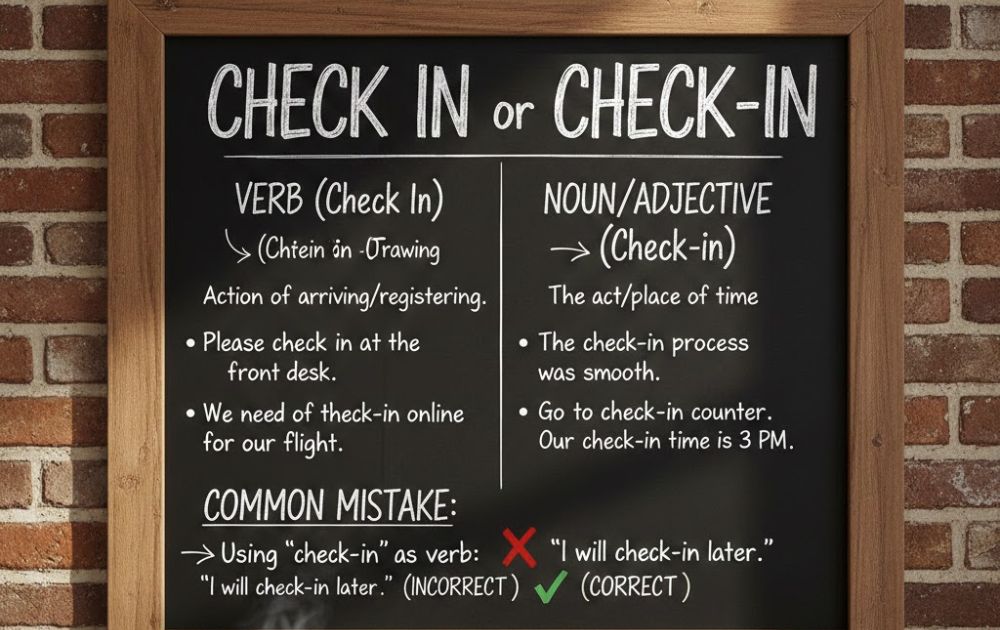
Confusion around check in or check-in shows up everywhere—emails, travel bookings, school instructions, and even official documents. While the difference looks tiny, that small hyphen completely changes how the phrase works in a sentence. Many readers pause and ask the same question: Am I supposed to write check in, check-in, or even checkin?
This guide clears up that confusion once and for all. Instead of giving shallow grammar rules, it explains how real English uses these forms, why the hyphen matters, and how meaning shifts depending on context. If you have ever hesitated before typing the phrase, you are in the right place.
Connecter or Connector: What’s the Correct Spelling?
Check in vs. Check-in (vs. Checkin)
At first glance, all three versions seem interchangeable. However, English grammar treats them very differently.
Check in works as an action. It tells the reader that someone is doing something.
Check-in works as a thing or a description. It points to a place, time, or process.
Checkin, without a space or hyphen, is usually incorrect in formal writing.
This distinction explains why check in vs check-in continues to confuse writers. The phrase changes meaning based on how it behaves in a sentence, not just how it looks.
Check in or Check-in? When to Use Both
Understanding check in or check-in starts with parts of speech. English often turns the same words into different forms depending on how they function.
When you use check in, you describe an action. Someone arrives, confirms information, or follows a required step. The phrase answers the question “What is happening?”
When you use check-in, you describe a noun or adjective. The phrase answers “Where?”, “When?”, or “What kind?”
That difference explains why style guides insist on context. The phrase adapts to the sentence, which is why both versions remain correct in modern English.
Writers often search for check-in or check in rules, but the better approach is to ask what role the phrase plays. Once you identify action versus description, the correct form becomes clear.
Which Came First? Origin of Use
The history of check-in begins in the early 1900s, closely tied to the travel and hotel industry. Railroads, shipping companies, and hotels needed a term for the designated place where travelers confirmed tickets and received instructions.
That early usage treated check-in as a noun. It referred to a physical location or scheduled time. Expressions like check-in desk and check-in time appeared long before the verb form became common.
Later, English naturally evolved. Speakers began describing the action of using that area. From there, check in emerged as a verb phrase. Someone would check in at the front desk or check in before departure.
This order matters because it explains why the hyphenated form still feels official. The noun existed first. The verb followed. That evolution supports why is check in hyphenated depends entirely on usage rather than preference.
Oversight vs Oversite: Pointing Out the Differences
When to Use Check In
Use check in when the phrase shows action. It behaves like a verb and often appears next to a subject and object. The sentence focuses on what someone is doing.
Common meanings include:
- registering upon arrival
- confirming details
- checking on someone’s well-being
In everyday English, check in often pairs with prepositions like at, with, or on. That structure reinforces its role as a verb phrase.
Examples
She arrived early to check in at the hotel before the conference began.
Before finalizing the booking, he decided to check in with the airline about seat availability.
Parents often check in on their children during long trips.
The manager asked staff to check in by 4 p.m. to confirm attendance.
In each sentence, the phrase shows an action taking place. Removing the hyphen keeps the meaning clear and grammatically correct.
When to Use Check-In
Use check-in when the phrase names something or describes a noun. In this role, it functions as a noun or adjective rather than an action.
Writers use check-in to talk about:
- a specific location
- a scheduled time
- a designated process
That distinction explains why signage, tickets, and schedules rely heavily on the hyphenated form. It labels things rather than actions.
Examples
The hotel offered an early check-in for guests arriving before noon.
The check-in desk was located near the main entrance.
He missed the assigned check-in time and had to wait.
They installed a new check-in system to speed up arrivals.
Here, the phrase points to a thing or concept. Using a hyphen signals that shift clearly.
Cheff or Chef: Understanding the Difference
Common Confusion: Checkin or Check-In
Many writers accidentally type checkin or check-in as one word. While spellcheck sometimes ignores it, standard English does not.
Checkin appears occasionally in informal digital contexts, especially in app names or internal systems. However, it rarely appears in formal grammar guides or professional writing.
For clarity and correctness:
- avoid checkin in articles, emails, and academic work
- choose check in or check-in based on function
That choice keeps your writing polished and professional.
Is Check In Hyphenated in Modern English?
The question is check in hyphenated has a simple answer with a nuanced explanation.
No, check in is not hyphenated when used as a verb.
Yes, check-in is hyphenated when used as a noun or adjective.
Modern English follows function-based rules rather than fixed spelling. Style guides like AP and Chicago agree on this distinction, especially in travel, business, and academic contexts.
Understanding this rule helps writers avoid one of the most common grammar mistakes online.
Practical Tips to Remember the Difference
Instead of memorizing rules, use this quick test.
If the phrase answers “What is happening?”, use check in.
If the phrase answers “What thing or time?”, use check-in.
That simple shift instantly clears confusion and improves sentence clarity.
Conclusion
Understanding the difference between check in or check-in improves clarity, professionalism, and confidence in writing. The hyphen is not decorative; it signals how the phrase functions. Use check in for actions and check-in for places, times, or descriptions. While checkin or check-in may appear online, only the spaced or hyphenated forms follow standard grammar. Once you focus on function instead of appearance, the confusion fades. With practice, choosing the correct form becomes automatic, helping your writing sound natural, accurate, and polished in every context.
FAQs
What is the difference between check in and check-in?
Check in is a verb showing action, while check-in is a noun or adjective referring to a place, time, or process.
Is check in hyphenated in proper English?
No, check in is not hyphenated when used as a verb. The hyphen appears only in noun or adjective forms.
Can I write checkin instead of check-in?
No, checkin is considered informal and incorrect in standard writing. Use check in or check-in instead.
Which form is correct for hotels?
Hotels use check-in for desks and times, but guests check in when they arrive.
Why does check in vs check-in confuse writers?
The same words change meaning based on function. The hyphen signals whether the phrase shows action or describes something.